



New Royal
“Huge amounts of parcels traffic went through the station in those days, especially from Boots and Beeston Boilers … to every place imaginable.” – Sir Neil Cossons (1950)
Showing all 5 results
Showing all 5 results
The Evolution of the New Royal Radiator
What was the Beeston New Royal Radiator?
The Beeston New Royal Radiator was introduced as a direct competitor to the National Radiator Company’s ‘Neo Classic’ model during the early 20th century, a period marked by a shift towards Edwardian column radiators. The early 1900s saw a growing demand for simpler, more functional radiators, replacing the ornate and school radiator designs that had previously dominated the market.
Like many of its contemporaries, the New Royal Radiator features the characteristic arrow or inverted “V” pattern at the top of its outer columns—similar to the Neo-Classic and designs like Castrads’ Mercury radiator.
Similarities aside, the legs of the New Royal are more bowed compared to the Neo-Classic’s wider, flared legs with a central indentation. Another key difference is that competing manufacturers often featured bushes engraved with ‘Ideal’ or ‘Crane,’ while Beeston opted for smoother, flush-finished bushes in their New Royal and more modern designs.
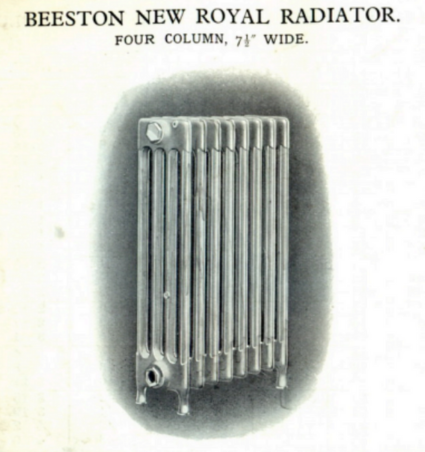
1920s
In 1924, the Beeston manual listed the Royal Radiator, which served as the precursor to the New Royal. Unlike its later iterations, the original Royal Radiator was a more traditional Edwardian column radiator, available in both three and four column versions. It lacked the signature arrow indentation at the top of the columns that would become a hallmark of the New Royal design.
The 1920s marked a transition period in radiator design, with Edwardian column radiators growing in popularity as they replaced older, bulkier school and ornate radiators. Beeston, recognising this shift, sought to keep pace with their competitors by launching their own version of this design, setting the stage for the later development of the New Royal.
Image: The Beeston Royal radiator as displayed in their 1924 catalogue.
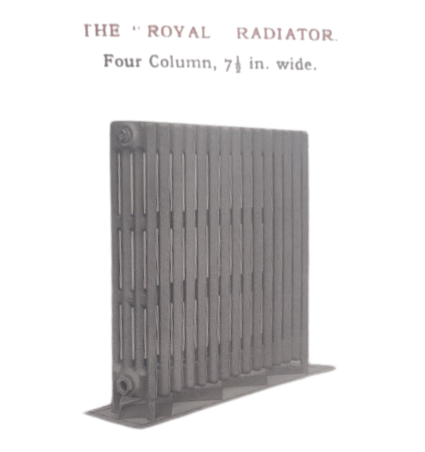
1930s
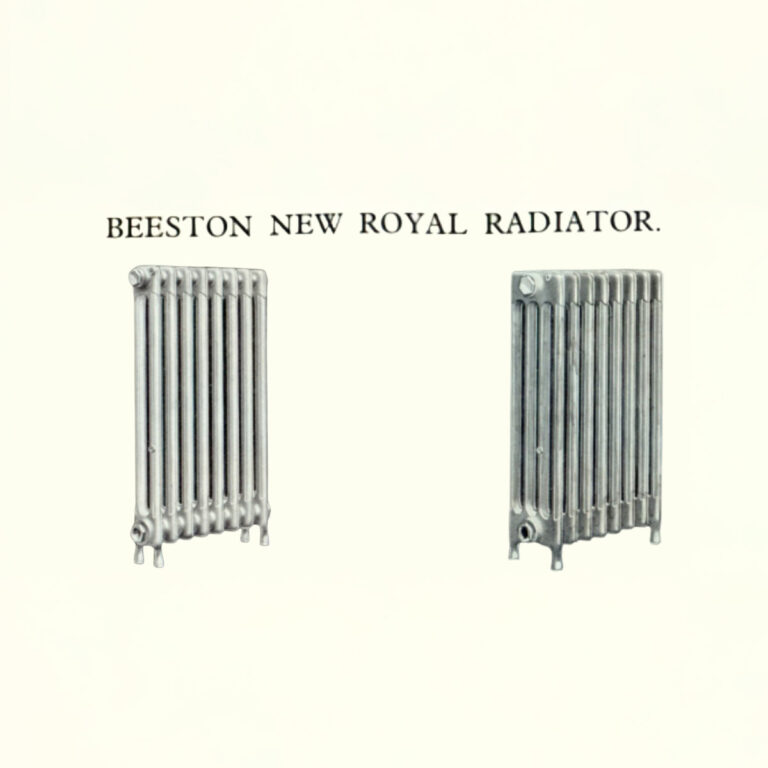
By 1936, the first New Royal Radiator appeared, offering a more refined and modern design compared to its Royal predecessor. Beeston removed the cross-braces between the columns, simplifying the radiator’s appearance and creating a cleaner, sleeker profile. The most notable change was the addition of the distinctive inverted “V” pattern at the top of the columns, which helped align the New Royal with the popular design trends of the time.
In 1936, the New Royal was available in 2, 3, and 4-column versions, catering to a wider variety of spaces and heating requirements.
Image: The Beeston New Royal radiator as shown in their 1936 catalogue.
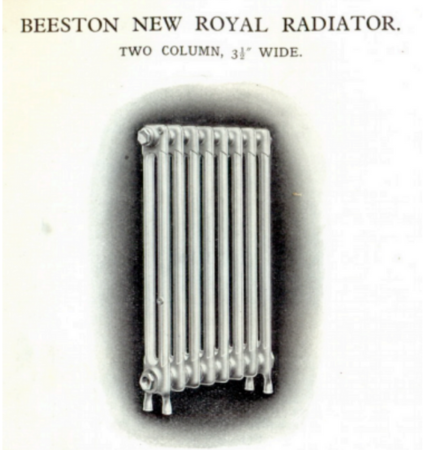
1950s
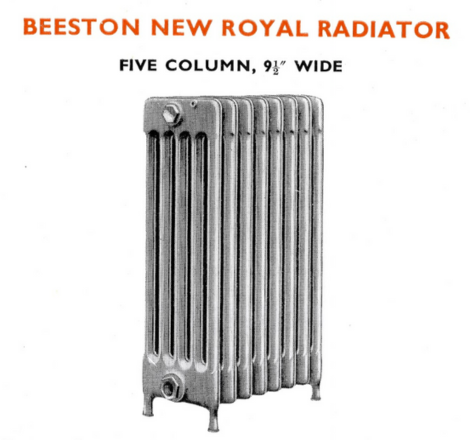
The 1950s saw further development of the New Royal Radiator, with Beeston introducing additional variations, including a 6-column version. However, by this time, the basic design of the New Royal had already been fully established, and no significant alterations were made beyond these new depths.
Despite these additions, the 1950s and 60s marked the beginning of the decline for cast iron Edwardian column radiators. By the 1970s, mechanical difficulties and changes in the heating market led Beeston to close their radiator line, marking the end of an era for the New Royal and Beeston’s role in the radiator industry.
Image: The Beeston New Royal radiator as show in the 1954 Beeston Boiler Company catalogue.